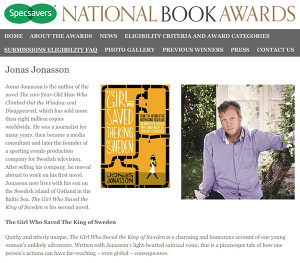
We received some wonderful news that we are delighted to share with you. Jonas Jonasson is on the National Book Awards shortlist for International Author of the Year 2014!

The Prize is awarded to an author outside of the UK for a new book, an outstanding literary and commercial achievement, combined with a high profile and strong sales. The winner will be announced on the 19th of November. Previous winners are Gillian Flynn (2013), Eowyn Ivey (2012), Jennifer Egan (2011) and Jonathan Franzen (2010).


Pic Jonasson_InternationalAuthorOfTheYear2014_web

See the full 2014 shortlist here.

Jonasson is in great company on this honorable and exciting list. Hopefully we come back to you the 19th of November with more good news! In the meantime we keep our fingers crossed for him and his wonderful novels!


We are pleased to present to you our brand new fall catalogue! The list includes new work by Sara Kadefors, Katerina Janouch and our first Spanish author Álvaro de la Rica.  You can find the catalogue here:

Kadefors latest novel His Name was Nathan has been published in September by the Swedish publishing house Piratförlaget. The book is a captivating tale about the power of love and its ability to heal and comfort, but also to divide and destroy. A book that depicts our present society astutely.

kadefors_hon_som_alskade_honom_2

The Spanish author Álvaro de la Rica is a professor of World Literature at the University of Navarre and author of important works among them Seven Meditations on Kafka, (Kafka y el holocausto, Trotta Editorial, 2009) an essay about Kafka that received raving reviews and will be published in France this fall by the renowned publishing house Gallimard.

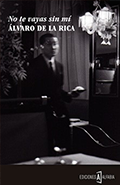
DontLeaveMeBehind_web

De la Rica newest work Don’t Leave me behind (No te vayas sin mí, Ediciones Alfabia, 2014) is a gripping cosmopolitan love story told in different voices. We follow the intellectual and emotional voyage of Jacob, destined by his cultural, literary and Jewish heritage to suffer in his decisions. Staten Island, the parks of Boston and Geneva’s Old Town, among other places are witnesses to a great love story that, perhaps, could have been yours and mine.  Don’t Leave Me Behind includes his first novella The Third Person (La tercera persona, Ediciones Alfabia, 2012) which he rewrote to be fully incorporated in this final literary version.

We at Brandt New Agency hope you had a wonderful summer and that you are as thrilled as we are at the beginning of a new literary season! There is a lot of news from recent weeks, which we are delighted to share with you.

To begin with…Katerina Janouch’s latest novel, Blood Sisters has gone directly to #2 on the Swedish bestseller list. Blood Sisters is the latest episodes in Janouch’s popular Cecilia Lund series and it gratifying to see that Swedish readers love the book as much as we do.

blodsystrar_WEB

There is also exciting news about our witty YA title Lex Bok by Sara Kadefors, with the Spanish and Catalan rights being sold to Destino/Planeta and Grup 62. The novel tells the story of Lex, a teenage girl who hates the world and thinks everyone is an idiot. But when she creates a blog, her alter ego, Maya, becomes extremely popular and Lex suddenly has to deal with fame. News about Sara Kadefors’ new novel will be posted soon on this website!

Danny Wattin’s Herr Isakowitz’ Treasure continues to thrill foreign publishers and rights have now also been sold to Forlagid in Iceland. The book has been sold to 12 territories and the first translation will be published in Holland by Uitgeverij Q at the end of October.

Our Fall Catalogue is almost finished and will be presented very soon. As always, our team will be attending the Gothenburg and Frankfurt book fairs.

Last but not least, we are pleased to introduce you to Elin Hellström, who is joining the  Brandt New Agency team as a literary agent.

Elin (1981) grew up in thousand-year-old Skara, one of Sweden’s oldest villages. As a child she enjoyed every subject in school except mathematics and loved spending time reading and playing in the Swedish outdoors. At 18, she left her sleepy hometown and headed for Latin America, inspired by her father who had worked and lived there. She studied Spanish Philology and Literature, first in Santiago de Chile and then at Lund University in Sweden and Alcalá de Henares University in Spain.

Her curiosity about different peoples and cultures took her on various journeys around the world and lead to further studies in Social Anthropology. Elin also holds a Master’s degree in Journalism from the University of Gothenburg, Sweden. After working as a news reporter in Stockholm, she decided to settle in Barcelona where, for two years, she worked as a freelance journalist for Swedish newspapers and magazines before joining Brandt New Agency.

Elin_web


Boel Bermann (1979) is a born storyteller. She used to work as a reporter for several large newspapers and is a member of the Swedish collective, Fear. Besides writing world-famous video games, she has also written her debut novel, The New Children: a fast-paced, gripping and heartbreaking dystopian tale, published by Swedish publisher Kalla Kulor Förlag in 2013. The New Children received rave reviews and appeals to readers of all ages. We are delighted to introduce this all-round debutant. We talked with her about what dystopian novels can teach us and how to make the unbelievable believable.


boel_cover

BNA: You are working in the games industry. What do you exactly do?
I work for the Paradox Development Studio games company and I have the amazing job of being a game writer for a role-playing game based on Norse mythology. I create characters, quests and events and try to challenge the player with the adventures they face and provide them with enough choices to create their own story.

The strangest part is that being a game writer and being an author is completely separate in my mind. I go to work and delve deep into Norse mythology and write fantasy in English about gods, trolls and rune stones. Then I come home and keep writing – but then I write science fiction in Swedish and explore the future. I think I separate the two by writing in different languages and different genres, so one is my work and the other is my creative hobby.

BNA: How does that experience help you with your writing?
It makes me think out of the box. When writing a novel, you choose what your characters do. But in a game, the person playing your game is deciding and you need to be prepared for the gamer to choose anything. I think it helps me to think of all the possible ways in which my stories could go and not just stay attached to one path.

BNA: We are told you love horror and sci-fi. Where does that fascination come from?
From reading the news, actually. Every time I read the news, I feel the urge to change the world and the future. Sometimes it´s really hard to relate to news that is very close to your reality, so I actually think it´s easier to relate to the things we face every day if we place them in a fictional setting in the future. I love thinking about the future, about things that may come and threats and trends we can prevent.

BNA: The New Children is your debut. Could you briefly explain what the novel is about?
In the novel, no children are being born and the world is in shock. After a few years, women begin to get pregnant again, but the new children are not like children used to be. They don’t play games or show emotions, they only watch silently. Against her will, the main character, Rakel, becomes involved when she accidentally kills one of the new children. She is among the first to realize that the new generation is a threat to humanity’s very existence.

BNA: Why did you choose to write this story?
I wanted to make people think about how they would react to the fact that humanity is dying. About what we humans are prepared to do for our own survival. I don´t believe humanity is evil, but I´m convinced that, to preserve what we have, we would go far beyond what we believe ourselves capable of. To protect the persons we love and to avoid seeing things that hurt.

BNA: The book is also about a new generation that develops faster than ‘normal’ people. How did you come up with such a brilliant but terrifying idea?
I wanted humanity to be certain that they are the last generation of their kind. But with the new children growing up, they would still be distant, they would always be younger than us. So I decided that if they developed faster, they would be a more real threat because they might even take over before humanity has died out.

BNA: The main text is interspersed with news articles and interviews. Why did you use this structure?
My main character Rakel is quite introvert and views the world with a distant gaze. So I wanted the novel to give something more than her point of view, due to the fact that she is so focused on her own life. I wanted a larger perspective, but I only wanted one main story – the one Rakel lives through. Therefore, in parallel to the story, I decided to use fictional in-depth interviews from research articles to get short freeze frames of different people’s views of the world.

The newspaper articles were a result of my own frustration with how much I fail to grasp of what is going on in the world. Even though I follow the news every day, I still feel that I only get bits and pieces that rarely come together to create a bigger picture.
What I hope is that the articles add to the sense of realism of the story and make it more believable as well as giving a brief overview of how someone would perceive everything that is happening.

BNA: The story is a real page turner. How did you manage to keep up the pace?
I never wanted the reader to feel safe or relaxed. I usually cut the scenes down and left them unfinished, because I wanted the reader to create them in their own minds. Strangely enough, I didn’t think of the novel as a page-turner when I wrote it, probably because I actually knew most of what would happen. But I realized that it’s nearly impossible to put down once you start reading, which of course is marvelous.

BNA: The main character Rakel is an anti-hero who lives a dissolute life: she sleeps with different men, is often hung over and, on top of that, she kills a child. Why did you choose her as the main character?
I wanted the main character to feel like a real person, and I don´t really believe that there are people that are all good. Even good people can do bad things and have destructive personality features. But I have to admit that I also love to write in the first person when the main character is hard to identify with, because then I´m actually forcing you as a reader to see the world from her point of view.

Of course Rakel is a very broken person. I wanted her to evolve so, in the first part of the novel, she is quite passive. She doesn’t care about the end of mankind, she mostly cares about her everyday life. Then, without giving any of the story away, she changes in the latter part – finding something that actually makes her act rather than react. But she did drive me insane sometimes: I’d sit there and curse at the computer. Oh come on, do something and stop looking at the world as if it were pitch black all the time. Rakel and I are very different people, and I doubt we’d be friends if she were real.

BNA: Was it difficult to write about the future?
The future portrayed in The New Children is extremely close in time and occurs in a society that largely resembles our own. I wanted to explore how the human race would react when ordinary people realize that they are probably the last generation of their kind. What is the private, political and social? One reviewer wrote something that meant the world to me: “I think that the dystopian lies as much in the present as in the future as depicted, for the unacceptable is already happening, and the monsters already exist.’’

BNA: We know that dystopian novels are one of your favorite genres. Why is that?
I’ve always loved dystopias because they are in between everyday life and the end of the world as we know it. You still have a society where people try to live their everyday life, but the structure of society is withering away. The strength of dystopias is that they make the reader ask: What would I do? Would I strive to change anything or just look the other way? Since I stay so close to today’s reality, I didn´t have to invent a completely new world, I only had to twist and bend the world we live in and then see what would happen…  

BNA: How did the writing process go? Did you face any difficulties?
With a full time job and a social life, the writing did take time. I mostly wrote during vacations, evenings and in meetings of my writing collective, Fear. I didn’t have many problems writing the novel; it came very naturally. My real challenge was in the later part when I had to edit it. I’m critical, so I just kept cutting out pieces I felt were dead meat. That probably helped the novel’s pacing as well – since I removed a lot of the breathing space for the reader.

BNA: Which books or writers inspired you?
It seems that dystopias usually surface when the world is going through a crisis and right now we are in the middle of a wave of dystopias in literature. I personally adore Margaret Atwood’s novels, especially her Maddaddam trilogy, and I feel that her strength lies in  how she explores current social trends and pushes them right to the edge of what we can believe.

BNA: The New Children is beautiful but also heartbreaking. Didn’t you find it hard to write such an incredibly sad story?
I needed to believe in my main character Rakel, to believe she was real. Because if I didn’t believe in her, then nobody else would. I felt that if I could make the reader believe in Rakel, they would believe anything I told them in The New Children – even that the children being born were different. I wanted to make the unbelievable believable.

To watch the New Children Book Trailer click here.


Shortly after its publication in Sweden (Piratförlaget, 2014) Herr Isakowitz’s Treasure by Danny Wattin has already been sold in pre-empts and great auctions to eleven territories.

The novel, based on the author’s life and family, is a beautiful and gripping account of a grandfather, a son and a grandson who embark on a road trip to the pre-war German territories now included in Poland. Their mission is to unravel the secrets of their eccentric Jewish family and find the treasure their great-grandfather buried before he was deported.


HerIsakovitzSkatt_Omslag_Final                       dannyWattin blog


Wattin is one of today’s most intriguing and idiosyncratic Swedish literary talents, a view supported by the enthusiasm of publishers worldwide, who praise the way the author combines a feel-good road trip with the dark history of the Holocaust. They also applaud the cast of strong and eccentric characters and the author’s honest, personal voice. Other novels written by Danny Wattin are Excuse Me But Your Soul Just Died, 2009 and See you in the Desert, 2007.

Herr Isakowitz’s Treasure has been very well received by the critics. Lotta Olsson writing in Swedish newspaper Dagens Nyheter said ‘Herr Isakowitz’s Treasure is a surprisingly funny, beautiful, terrible and sad book about a father, a grandfather and a son on a road trip in search for a buried treasure and their family roots. The great grandfather buried the treasure in Germany, today Poland. The ones that could, escaped. Danny Wattin’s novels play with humor, not only about his own family but also about people’s possibilities and limitations and the presence of malice.’

Herr Isakowitz’s Treasure will be published as a leading title during 2014 and 2015 in the following territories:

Catalonia by La Campana

Czech Republic by Fortuna Libri

Denmark by Politikens Forlag

France by Presses de la Cité

Holland by Uitgeverij Q/Querido

Germany by Eichborn/Bastei Lübbe

Italy by Bompiani

Poland by Foksal

Russia by Corpus Books

Slovakia by Fortuna Libri

Spain by Lumen/Penguin Random House


stajordi2

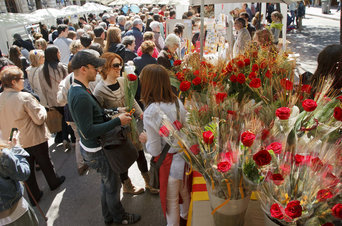
Sant Jordi, the 23th of April when Catalonia and its capital celebrates the day of the book ,is the day that 6 million roses and books are sold to the value of 19 million euros, a 10 % of the yearly sales. Spanish and Catalan publishers and booksellers are therefore gritty their books hit the bestseller list and await in tension till the first sales figures are announced.

It soon became clear that this year’s big winner is The Girl Who Saved the King of Sweden being the most sold novel in Catalan and the second in Spanish! With this wonderful reception and admiration received by the readers, Jonas Jonasson has achieved to be the most sold author both in 2012 and 2014 with his two novels, The 100 Year Old Man Who Climbed Out The Window And Disappeared and The Girl Who Saved The King Of Sweden.

stajordi1

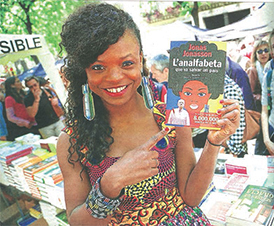
The novel received lots of attention on both radio and television and almost every newspaper covered the news that the Swedish novel is breaking records. A book stand at the crowded Rambla de Catalunya was totally dedicated to Jonasson’s second novel; a girl was  dressed up like Nombeke (wearing earrings in the shape of missiles) together with an actor in a pink suit representing the Hundred Year Old Man Allan. Jonas said that his next chicken will be called “Sant Jordi”.


Streets of Barcelona on Sant Jordi day

Jonas Jonasson interview

As a child she was already writing, knowing that one day she would write books. Now, more than thirty years later, the Swedish journalist Johanna Westlund (1978) has finished her debut novel Absence: a gripping story of solitude, mental illness and freedom of choice. We are delighted to introduce this gifted novelist and we talked with her about her debut novel, writing and how dance performances inspire her.
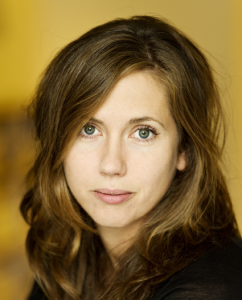
fMaxWestlund (1)

BNA: For the people who don’t know you, could you introduce yourself?

I’m a journalist who covers the publishing industry, and last year I co-founded a new literary magazine back in Gothenburg in Sweden, where I am from. The articles in Magazine Fyrahundrafemtio (which means 450 in Swedish) deal with the way literature and society are connected, something I’m very interested in. Right now I’m planning another media project, which is in the same spirit but will have a completely different outcome! I like to challenge myself, both in my work and in my free time, and I like adventure. I love travelling and seeing new things, reading and learning new things, and learning how to do new things –from writing a novel to surfing.

BNA: You have a lot of experience as a journalist. And you have just finished writing your first novel. Did your journalistic know-how help you write Absence?

Absolutely! Researching the novel was quite easy, since I’ve done a lot of research before. I’m also used to planning and structuring my own work, which was a great help in the enormous task of writing a novel. However, there’s a huge difference between reporting and writing a novel, and even though I’m a journalist I wasn’t prepared for the vastness and complexity of it. Writing a novel is much freer and liberating, but at the same time much more demanding, because the possibilities are endless.

BNA: Could you tell us briefly what the novel is about?

It’s a story about six young students who become friends. They are studying psychology and discovering the world together, but the more important side of this adventure is – of course – what’s going on beneath the surface and what happens to the characters’ psyches: as individuals, as a group, how they interact, and how the dynamics of power and friendship shift. And after a while it turns out that not all these psychology students are mentally suited to being future psychologists… The central character, Andrea, is introverted, scarred by her past, and very insecure. For her, studying at university and meeting these new friends is like coming home and finally starting to live. When she meets someone who has ulterior motives and does not necessarily want what’s best for her, she learns the hard way that not everybody is to be trusted. That forces her to make a difficult decision. But sometimes what looks like a loss can be a gain – and vice versa. It’s a story about loneliness, mental illness and freedom of choice. In a way, it’s also a psychological thriller that takes place inside someone’s head.

BNA: Absence chronicles the life of 21-year old Andrea. Why did you choose to write about a girl of that age?

When you’re 20 you know nothing and everything about life. You’ve just grown up, everything is new and exciting and the possibilities are endless. But it’s also an age where you are easily influenced, especially in all the new situations in which you find yourself. You are vibrant but also vulnerable. You fumble your way along, but you also fumble with great passion. The highs can be very high – but the lows can also be very low, especially for someone as scarred as Andrea. So it turned out to be the perfect age for the themes I wanted to write about.

BNA: There is a deep psychological game between the novel’s characters. Is university a good setting to create the necessary atmosphere and context for that?

I think it’s an excellent setting! The mix of uncertainty, curiosity and the thirst for knowledge and the skills you need to navigate life becomes more obvious in an environment where the aim is to learn as much as possible. University can, in a way, be a world of its own, with rules and expectations. It is a setting where you learn many things, meet new people and evolve. A perfect setting for a story about power and knowledge! I wanted my students to study psychology since I thought it would make a good contrast between what happens to them and what they study – practice versus theory.
Absence-University-1

BNA: How did the writing process go? What problems did you face?

One of my biggest problems was that I wasn’t sure I would actually be able to write the novel, and tie all the stories of the six characters together. I have done a lot of writing before – short stories, poetry, scripts, and of course piles and piles of articles – but when I tried writing novels before, I always lost interest in my own story or thought it was worthless and threw it away. But I can be very harsh on myself, so this time I decided that I had to be nice for once – to encourage myself and not scrutinize everything till after I’d written the whole story. So, in order to do that I allowed myself to be completely free in my writing – I had a basic storyboard as a foundation, but I wrote one scene here, one scene there, and did not edit much out until I had everything down on paper. This was great fun, but it also meant I had to do a LOT of scrutinizing, judging and editing later on. That was hard! But I think it was good, both for the novel and for me.

BNA: When you started writing Absence, did you already know what the story would be like?

Yes, at least in broad outline. I knew from the beginning exactly what would happen to the two main characters, Andrea and Bernhard, and how they would develop throughout the story, and most of what would happen with the other four characters. But I discovered a lot of things along the way. Everything evolved a lot and, in the end, some of the psychological experiments and theories became more important for the actual story than I expected them to be when I started writing.

BNA: Did you have to do a lot of research?

Well, I didn’t have to do it because everything is based on my imagination – not on a true story or an actual university. But at the same time I wanted to make the story believable. So I terrorized every psychologist and psychology student I knew – or that I met in the two years I was working on the novel, including complete strangers – with questions about their studies and about their feelings about the studies. I also had a lovely “focus group” of psychologists who analysed my characters. And I took a university psychology class myself – but that was not only for research, it was also because I’m genuinely interested in psychology.

BNA: Were you always writing from a young age?

Yes, I’m afraid I am one of the usual suspects who have always loved to read and write. As a child, my favourite class in school was the “story hour” when we got one hour a week to just sit down and write stories. And I also wrote a lot of poetry as a teenager – I still do once in a while. At 25 I made my first big effort to write a novel, but I threw it away after a couple of months when I realized it wasn’t a good story – it was just a way of processing what was going on in my own life (even more so than the teenage poetry, really!). I decided that the next time I tried to write a novel, I would have to have a great story to tell – not just my own life masquerading as a novel.

BNA: Which authors inspire you?

I have many favourites – for example, Joyce Carol Oates and Siri Hustvedt for language and themes, David Sedaris and Claire Castillon for their subtle humour and absurd darkness, Chimamanda Ngozi Adichie and Haruki Murakami for their modern but timeless epic novels. And that’s only a few of the contemporary authors I admire!
But in my own writing, other art forms inspire me even more than the written word. Film and photography always give me a lot of thoughts and ideas, as do live performances, and the best thing is dance – wordless depictions that I just have to put words to in my head. That always gets my mind going! I love sitting there in the dark theatre, watching and thinking, and then quickly scrawling all my thoughts down afterwards before I forget them.

BNA: You seem to be an adventurous type. You climbed Kilimanjaro, you love surfing and have travelled the world. Can we find that adventurous spirit in your novel?

Maybe in the fact that I wrote it at all? It was a bit of an adventure – deciding that “this is it”, that I was going to work hard and do everything I could to finish this novel and make it as good as I could. And maybe you can also detect this spirit in some details in the novel, such as Andrea’s growing courage, Cilla’s travels, and Peter’s restlessness.

BNA: Now the novel is written, are there any new projects readers can look forward to?

Besides my regular journalistic assignments, I am working on a non-fiction book about loneliness, and I’ve also just started writing my next novel. I’ll have to go to a lot of dance performances now!



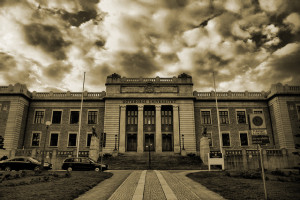
In the bookstores, when people ask for Dutch literature, they might end up with the current international bestseller The Dinner by Herman Koch, or the literary travel literature guru Cees Nooteboom followed by… who else?  It’s no secret that on an international level Dutch literature is not so well-known. Despite the always hard circumstances and possible marginalization a smaller territory with minority languages has to face, to be spread and read in the rest of the world, there is also a sensation of common loss of what many captivating books and gifted authors has to offer to readers and the market internationally.


frankfurt

Picture: AP Photo/Michael Probst


This will become clear during the 68th edition of the Frankfurt Book Fair in 2016 as Holland and Flanders will be Guest of Honour. Being guest of honour at the biggest book fair in the world is the best way to promote a territories’ literature. All kinds of events and exhibitions will be organized to make the entire publishing industry aware of many more incredibly talented Dutch and Flemish authors who you will never forget. And scouts, publishers, authors, agents and translators will join forces to make this possible.


dutchies blog web version 294x300


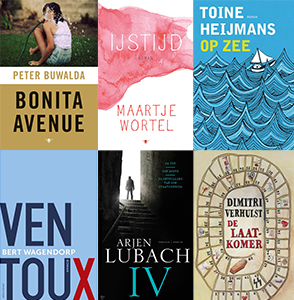
We would like to see much more of the engrossing work of the Flemish author Dimitri Verhulst. Or Peter Buwalda, whose novel Bonita Avenue has just been sold to Random House in the United States. Or the heartbreaking Tonio by A.F.T. van der Heijden, a personal account about the loss of his son. And what about Frank Westerman’s fascinating non-fiction books? Maartje Wortel? Hanna Bervoets? Tommy Wieringa? Toine Heijmans? Bert Wagendorp?  Arjen Lubach? Never heard of? Remember their names, cause in 2016 they will be on your book shelf!


  • February 14, 2014

We are proud to announce that we are representing on behalf of Shared Stories the Dutch bestselling titles The Latecomer by Dimitri Verhulst (Spain and Sweden) and Ventoux by Bert Wagendorp (Spain). Both books are strong, plot driven novels published in 2013 by Uitgeverij Atlas Contact and are a huge success in Holland where they hit the bestselling list for months.

The Latecomer by Dimitri Verhulst (May 2013, Altas Contact)

More than 80.000 copies sold!

cover The latecomer

Foreign rights sold to Portobello (Uk, World Rights), Luchterhand (Germany) and Denöel (France)

Original title: De laatkomer, pages: 140, genre: fiction

The Latecomer by Dimitri Verhulst tells the story of Désiré Cordier, an ordinary 74 years old man who is stuck in a loveless and boring marriage with the dominant and bitter Moniek de Petter. One day he decides to escape to hide in an old people’s home, pretending to be senile. Désiré appears to be a sublime actor! Although he has to fake incontinency and is surrounded by mentally disabled people day and night, he couldn’t be happier: he is not only separated from his wife, he also meets his childhood sweetheart Rosa who is a patient too. With Rosa on his side he feels younger and more free than ever before. Once he has opened up his mind and heart to the dramatic, uncontrollable and sometimes hilarious situations occurring amongst the senile patients, he fully enjoys the adventure of being alive…

The Latecomer is a fascinating and engrossing story, told in a captivating way and overflowing with dark humor, with the cynical voice that the bestselling and highly appreciated Verhulst has made into his personal literary style. The Latecomer has sold over 80.000 copies in the Netherlands and is highly praised by the literary critics!

Recently the Latecomer has been selected for ‘Books at Berlinale’ at the Berlin Film Festival. The selection was made from more than 120 books from over 25 countries and will be presented to experienced filmmakers and producers.


picture dimitri

Picture by Keppa


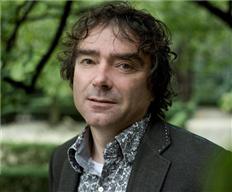
Dimitri Verhulst (Belgium, 1972) is considered one of the best writers in the Dutch language. Since his first book in 1999, he has published a constant stream of novels, plays and poetry. His breakthrough came in 2006 with the novel De helaasheid der dingen (The Misfortunates). The book won several awards including the Golden Owl Literature Prize and has sold more than 200,000 copies to date. The English translation was named one of the best books of 2012 by The Irish Times. The film The Misfortunates, directed by Felix van Groeningen, screened all over Europe, and won the Prix Art et Essai at the Cannes Film Festival’s Quinzaine des Réalisateurs and was the official Belgian entry for the Academy Awards.

In 2009 his book Goddamn Days on a Goddamn Globe was awarded the Libris Literature Prize. Dimitri Verhulst’s work has been published in more than 30 countries.

Watch here the book trailer of The Latecomer.

Ventoux by Bert Wagendorp (June 2013, Altas Contact)

More than 100.000 copies sold!

cover Ventoux

Foreign rights sold to btb (Germany), Turbine (Denmark), Galaade (France) and Kagge (Norway)

Original title: Ventoux, pages:288, genre: fiction

Bart Hoffman, crime reporter and cyclist, is almost fifty years old when his childhood friends André, Joost, and David come back into his life. They retrieve memories of the summer of 1982: the summer spent with his best friends, five men and one woman; the summer of his hopeless infatuation with the beautiful Laura; the summer of betrayal; and the summer of the death on Mont Ventoux. The five eighteen-year-old boys climbed the legendary mountain on their bicycles, and only four of them returned. An accident on the slopes claimed the life of Peter, the promising young poet, a tragic incident that shattered their near-magical bonds of friendship and drove the friends apart. Laura, Peter’s muse, vanished without a trace.

Thirty years later, in the summer of 2010, Laura invites the four men to visit her home in Provence, where she works as a theatrical director. The friends find themselves travelling back into their past, with their racing bicycles strapped to the roof, their lost years in the back seat, and their inner demons trailing behind them.

Ventoux is a moving tragicomedy about the nature of true friendship, a hilarious and insightful portrait of a generation, and a two-wheeled journey toward the consequences of youthful choices, in search of forgiveness and a new beginning. The novel sold over more than 100.000 copies.


Picture by ANP

Picture by ANP

Bert Wagendorp (The Netherlands, 1956) is a highly appreciated columnist at the Dutch daily De Volkskrant and the author of the novella De Proloog (The Prologue) and the short story collection De dubbele schaar (The Double Scissors). Producer Hans de Wolf of KeyFilm, director Nicole van Kilsdonk, and Bert Wagendorp have joined forces to make a film adaptation of the book.


The Hundred Year Old Man, the movie based on Jonas Jonasson bestseller, premiered in Sweden, Denmark and Norway on Christmas Day and is already breaking records! The movie starring Robert Gustafsson, is not only the most expensive movie ever made in Sweden, it is also one of the most popular movies in Swedish history. In only two weeks the movie has sold more than 762.000 tickets, grossing around $10 million!

Article in the Hollywood Reporter.

gala picture 4

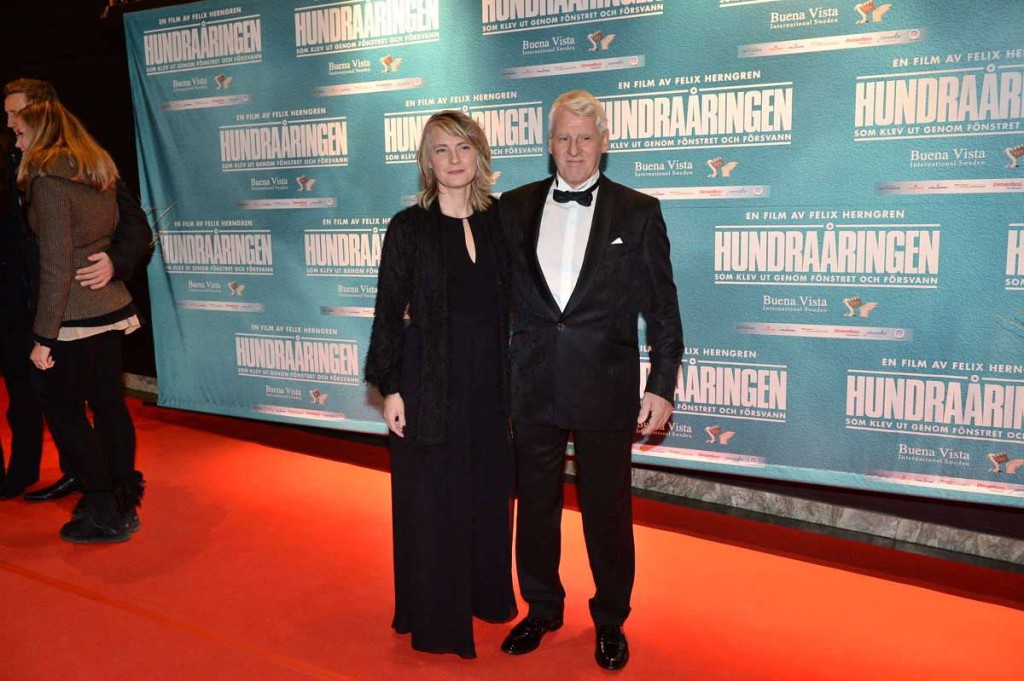
Carina with her father at the Gala Premiere last December.

At the Gala Premiere which we attend last December, director Felix Herngren was palpable moved and excited to show The Hundred Year Old Man for the first time to the audience after three years of hard work. The result is a truly captivating and highly entertaining film about the adventures of Allan Karlsson. In an interview with TV4, Herngren and main actor Gustafsson speak about the making off.

People outside of Scandinavia can enjoy the movie too as Studiocanal has sold the distribution rights to about 45 countries who will show the movie this year. Disney distributed in Scandinavia.  The Hundred Year Old Man was produced by Nice Flx.

gala picture 1 gala picture 3